Sometimes a survey leaves two options too close to choose. Sometimes it tells you what people selected but misses the words they use when nobody is asking them a question. Social listening is the systematic collection and analysis of relevant public online conversations to understand what people discuss, how they describe it, and how that changes over time. For a research team, it is most useful as another source of evidence, not a substitute for a designed sample. This guide explains where social data helps, where it can mislead, and how to combine it with surveys and interviews in a study a client can actually use.
What social listening can and can't tell you in a research project
Surveys ask the questions you wrote. Social listening starts with conversations people chose to have. It can reveal objections, category language, unexpected use cases, and the timing of a new concern before a quarterly tracker is fielded.
The tradeoff is control. You usually do not know enough about the people posting to treat them as a representative sample of category buyers. Some customers do not post at all. A few active accounts, bots, or a news event can distort the apparent size or tone of a conversation. Short posts are especially easy to misread without the surrounding thread.
| Good for | Not good for |
|---|---|
| Finding unprompted language, complaints and emerging questions | Estimating the share of all consumers who hold an opinion |
| Seeing when and where a public conversation changes | Proving why an individual chose a product or acted a certain way |
| Developing hypotheses to test with other methods | Comparing demographic segments when identities are unknown or unverified |
| Providing context for a survey result or interview theme | Calling a mention spike a lasting behavior change on its own |
The AAPOR report on social media in research describes its value and sampling limitations. Use conversation to investigate ideas, but a sound sample to estimate prevalence.
Social listening vs. surveys vs. interviews: when to use each
The methods answer different questions. Choosing one starts with the decision your client has to make, not the data source that happens to be easiest to open.
| Criterion | Social listening | Surveys | Interviews |
|---|---|---|---|
| Question type | What is being discussed without prompting? | How common is a stated view or behavior in a defined audience? | Why does someone think or behave that way? |
| Speed | Existing public conversation can be scanned quickly; cleaning takes time | Requires design and fieldwork before results are ready | Recruitment, conversations, and analysis take time |
| Depth | Natural language, often with limited context | Consistent answers across many respondents; limited probing | Rich context and follow-up questions |
| Sample control | Limited control over who speaks and who is visible | Audience, quotas, and questions can be specified; quality depends on sampling | Participants can be recruited to specific criteria, but small samples are not for prevalence estimates |
| Cost profile | Software or managed-service fees plus query design and review | Questionnaire, sample, incentives, and analysis | Recruitment, incentives, moderation, transcription, and analysis |
As a rule of thumb, social listening finds what people bring up and how they say it; surveys size a defined pattern; interviews explain why it matters. None verifies every finding from another.
Three ways to combine social listening with survey and interview data
Break ties when survey results are too close
If a concept test produces similar results for two campaign directions, do not declare a winner from a marginal difference. Review sample uncertainty, then examine category language and objections in social conversation. Interviews can probe either direction before the team recommends one.
In a published thinqinsights concept-testing case study, a snack brand's survey did not clearly separate two campaign routes. The team brought raw survey data together with consumer trends and social insights in Meaningful and produced a grounded creative recommendation. The social material added context to the decision; it was not a new representative vote for either concept. If you add evidence after seeing the survey, disclose that sequence and the criteria used to interpret it.
Spot emerging needs before they appear in your questionnaire
An existing questionnaire is good at tracking what you anticipated. It is less useful for an objection or workaround you never thought to ask about. Scan relevant conversations early for recurring expressions of friction, new comparisons, and questions customers ask one another.
Turn themes into neutral survey items and interview prompts. If people discuss confusing subscription terms, test which terms buyers understand and ask how they compare offers. Posts support the hypothesis, not its prevalence.
Build segment profiles from several sources
A segment profile needs context as well as scale. Surveys show how groups differ; interviews explore motivations; social conversation and desk research reveal the wider category discussion.
The same thinqinsights case study describes an emerging-technology project that combined a quantitative survey, market analysis, and social scraping to build profiles by industry vertical. The published account says synthesis that would have taken weeks took hours. That is a reported result from one agency, not a standard delivery time for mixed-method research.
A step-by-step workflow for a mixed-methods study
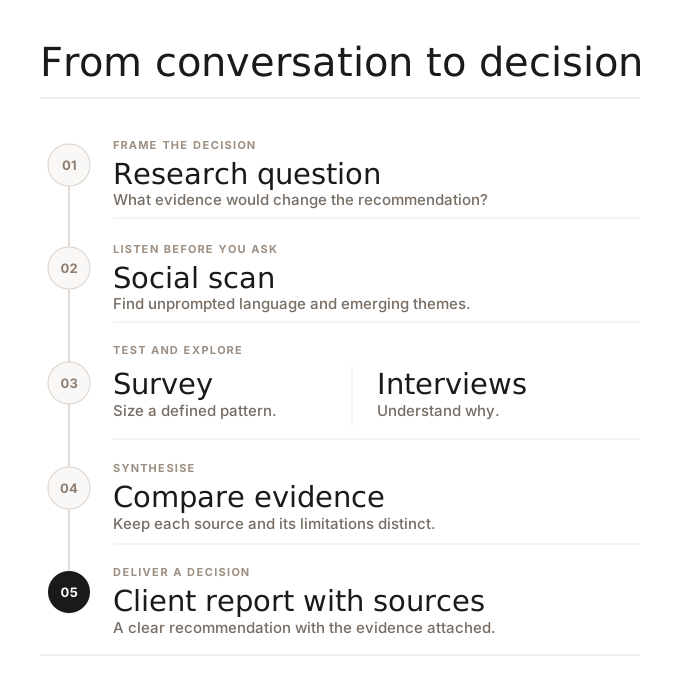
Start with the decision. Use a social scan to inform the instruments, then bring each source back together with its original context intact. Open the diagram at full size.
-
Define the research question. Write down the client's decision and what evidence would change it. “What do people say about the category?” is a topic; “Which unmet need should shape the next product concept?” is a research question.
-
Scan public conversation for themes. Choose sources, keywords, languages, markets, and dates that fit the question. Review false matches and unusually active accounts before summarizing; search results are not yet a research dataset.
-
Design the survey and interview guide. Convert the themes into testable questions without copying loaded or leading language. Keep space for an open response or probing question so a new explanation can still emerge during fieldwork.
-
Run fieldwork. Recruit the audience required by the decision under a documented design. Note where respondents overlap with the social population; public discussion and a recruited sample may reflect different people.
-
Bring the sources together. Tag each item by source, date, market, audience, and method. Compare themes across sources, but keep denominators and limitations separate: a count of posts is not a survey percentage, and a vivid quote is not a segment estimate.
-
Synthesize and report. State what each source supports, where they disagree, and what remains uncertain. Show the client a clear recommendation with links or references back to the material behind it, rather than a blended score that hides the methods.
What to document so the findings are defensible: Record the platforms and communities searched; collection dates and date range; keywords and Boolean logic; languages and geography; exclusions, duplicates, and suspected automated posts; how themes were coded; and what the survey and interview samples can represent. Keep enough source context to audit an interpretation without exposing unnecessary personal data.
How to choose a social listening approach
A self-serve tool suits frequent scans when someone can tune queries and review false positives. Brandwatch, Sprinklr, and Meltwater are examples of dedicated social listening tools. Check source coverage for your market before buying.
A managed service can fit an occasional study when specialists define the search, clean the material, and deliver a synthesis. Ask what raw material remains accessible and how exclusions are recorded. Either way, a researcher must interpret the evidence.
Use the same checklist for either route:
- Data access: Which platforms and time periods are covered, and what cannot be collected?
- Sampling transparency: What does a “mention” count, and how are duplicates, bots, paid posts, and reshares handled?
- Privacy and location: Where are raw posts, identifiers, and final results processed and stored? Is the intended use permitted by platform terms and applicable privacy rules?
- Reporting format: Can the team inspect source context and combine the output with survey and interview evidence, or will it receive only aggregate charts?
Public posts can still contain personal information. ESOMAR's social media research guidance and privacy regulators' guidance on public-data scraping are useful starting points for designing a lawful, proportionate collection process.
Common mistakes
- Treating volume as sentiment. A spike in mentions may reflect news, controversy, paid activity, or reshares; read the posts and the surrounding event.
- Ignoring source bias. A vocal online community cannot stand in for all buyers, even if the dashboard displays a large number.
- Letting automated or irrelevant posts set the theme. Check bot-like activity, duplicates, keyword collisions, and conversations that use the same term in another context.
- Skipping validation. Bring important hypotheses into a survey or interview when the decision depends on prevalence or explanation.
- Leaving out the method note. A client report should say what was searched, when, what was excluded, and what conclusions the data can and cannot support.
Frequently asked questions
Is social listening a replacement for focus groups?
No. It captures public, unprompted conversation but cannot ask follow-up questions or control who participates. Focus groups can explore how participants respond to a stimulus and to each other; use social listening to inform what you test and the language you bring into the discussion.
Can social listening data be used alongside survey data?
Yes. Use social conversation to form hypotheses and survey questions, or to add context to an unexpected survey result. Keep the sources labeled separately: posts do not have the same sample design or denominator as survey responses, so their counts should not be presented as comparable percentages.
What software combines survey results with social media trend data?
Look for a mixed-methods research platform that accepts survey data and social findings in the same project and links the final interpretation to both sources. A social listening tool plus a survey platform can also work, but the team will need a method for reconciling, reviewing, and reporting the evidence.
How do you spot emerging customer needs from social data?
Look for repeated workarounds, newly phrased complaints, changes in comparisons, and questions that existing surveys do not cover. Check the date and source of each pattern, then test the underlying need with interviews or a survey before deciding how many customers share it.
Is social listening data reliable enough for client reports?
It can support claims about what appeared in a clearly defined public conversation, especially when the search and exclusions are documented. It should not, by itself, support claims about the proportion of all customers who believe something. For consequential decisions, triangulate it with a designed sample and preserve the source trail.
Bringing social, survey and interview data into one place
The useful output of a mixed-methods study is a conclusion the client can inspect. That requires the survey result, the interview explanation, and the relevant social context to remain distinguishable even when they inform the same recommendation.
Meaningful runs surveys and AI-moderated interviews in a client workspace and can bring in aggregated social-listening findings through an optional managed service. Its published data agreement says social collection happens in a separate sandbox and only aggregated, anonymised results enter the workspace. Teams can synthesize those sources and produce reports or decks while keeping the researcher responsible for interpretation.
Request a demo to see how that workflow fits your next study.